
Where VP Actually Comes From
Killing a unit scores the VP printed on that card; rescuing a friendly garrison or destroying an enemy one scores two VP each; controlled objectives and scenario conditions add more. Most scenarios are won on total VP at the end of the second Phase.
Most Gundam Assemble scenarios are won on victory points at the end of the second Phase. There are four ways to score, and they are not equally efficient.
The four scoring routes
| Route | Points | Cost |
| Destroy an enemy unit | VP printed on that unit's card | The attacks needed to remove its hit points |
| Rescue a friendly garrison | 2 | One Primary Action plus 2 timeline, adjacent |
| Destroy an enemy garrison | 2 | One or more damage to the token |
| Control objectives / meet scenario conditions | As the scenario card states | Board position and activations |
|---|
Kills look like the main route because the numbers are printed on every card, but they are usually the slowest. A three-dice attack averages 2.1 damage; removing a 15 HP unit takes about seven of them.
What each unit is worth
The VP value on the card is what your opponent scores when they destroy it. The launch pool ranges from 5 to 10.
| VP | Units |
| 5 | TOLRO-800 Torohachi |
| 7 | Char's Zaku II, Gundam Vidar, Guncannon, Guntank, Delta Plus, Gundam Pharact |
| 8 | ST01 RX-78-2 Gundam, Darilbalde |
| 9 | Wing Gundam Zero (EW), Gundam Epyon (EW) |
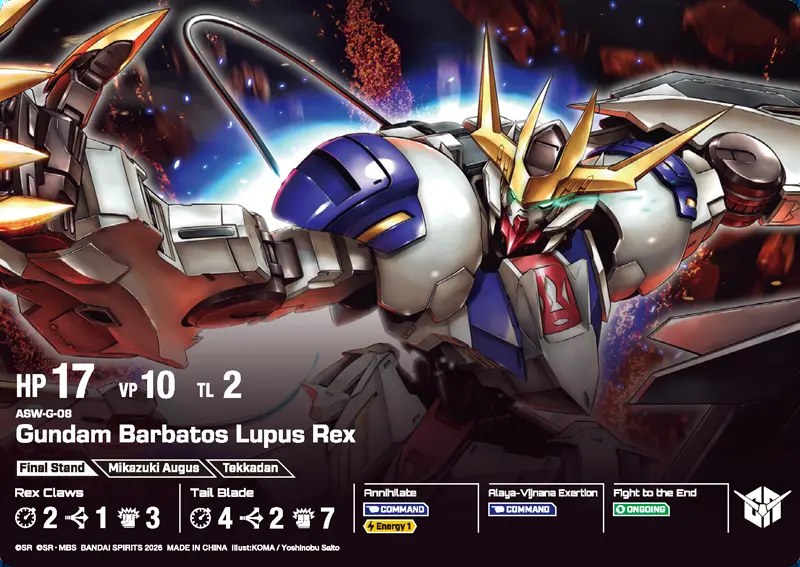
| 10 | Gundam Aerial, Unicorn Gundam (Destroy Mode), Barbatos Lupus Rex, PA01 RX-78-2 Gundam |
|---|
Read that table as a threat list. Every 10 VP unit on the board is a target, and every 5 VP unit is a cheap screen that gives your opponent almost nothing.
The exchange rate
VP per hit point is the cleanest way to compare targets. Divide the card's VP by its hit points and you get how much you are handing over per point of damage the opponent has to do.
- Wing Gundam Zero (EW): 0.75 - the most generous target in the pool
- Unicorn Gundam (Destroy Mode): 0.71
- Darilbalde: 0.62
- Gundam Aerial: 0.63
- Torohachi: 0.63
- Barbatos Lupus Rex: 0.59
- PA01 RX-78-2: 0.59
- Guncannon: 0.58
- Char's Zaku II: 0.58
- Gundam Pharact: 0.58
- Gundam Epyon (EW): 0.60
- Delta Plus: 0.64
- Gundam Vidar: 0.54
- Guntank: 0.54
- ST01 RX-78-2: 0.53
The spread is only about 0.2, but in a game where you might destroy two or three units, it is the difference between a comfortable win and a loss.
Objectives and scenario points
Objective control is scored "as instructed by the scenario" - the scenario card is the authority, not a universal table. In practice this means the same board state can be worth different amounts in different scenarios, and reading the scenario before deployment is part of scoring.
Scenario objective cards can award additional VP for specific conditions. These are usually the swing points in a close game, because both players tend to focus on kills and forget the printed condition until it is met by one side.
Timelines and VP
A destroyed unit's Timeline token moves two rounds forward rather than being removed. It will not activate again, but it still sits on the track. In scenarios where the number of rounds or the position of tokens matters, that is a real detail rather than bookkeeping.
Destroying a unit also has a hidden VP effect: every activation your opponent loses is an activation you gain relative to them. A 10 VP unit that was about to act twice more is worth more than 10 VP in practice.
End of game
The game ends after Phase two, at the end of round twenty. Most scenarios award the win to the player with the most VP. Ties are resolved by the scenario, and where the scenario is silent, the usual house answer is to compare destroyed unit VP.
If you are learning, the single highest-value habit is keeping a running score aloud. It stops the last two rounds from becoming an argument, and it makes the objective-versus-kill decision obvious while you still have time to act on it.
For how the objectives themselves are contested, see scenarios and objectives; for the cost side of scoring, see combat and dice.