Terms You Will Hear at the Table
Timeline is the shared round track; a Phase is ten rounds; a garrison is a token you rescue or destroy for two VP; Energize trades two timeline for one Energy; Mass Produced is the trait that lets you field duplicates.
Every term the rulebook uses, in the order you meet it.
Core terms
Activation - one unit's turn within a round. The unit takes its actions, then its Timeline token moves forward by the costs paid.
Advance - the free movement action, up to three hexes, once per activation.
Attack dice - ten-sided dice rolled for attacks. A hit is 4 or higher; 9 or 10 is also a critical.
Base - a scenario object that can be attacked or defended, depending on the scenario.
Carrier - a scenario object, generally larger than a base, used in deluxe games with battleship-class units.
Command ability - an ability marked Command, usable once during the unit's activation.
Critical hit - a die result of 9 or 10. It hits regardless of Accuracy modifiers and can trigger the weapon's critical effect.
Energy - a resource token placed on a unit card, spent by stronger weapons and abilities. Gained by Energizing.
Energize - a Primary Action: spend two timeline to place one Energy on the unit.
Garrison - a token on the map worth two VP, either by rescuing it (friendly) or destroying it (enemy).
Line of sight - the requirement that a unit can see its target, checked against terrain and units.
Mass Produced - a trait that lifts the duplicate restriction, allowing multiple copies of that card number.
Objective - a marker on the map, contested by units ending their activation on or adjacent to it.
Ongoing ability - an ability that is continuously active while its stated condition is met.
Phase - ten rounds. A game is two Phases.
Primary Action - one of Attack, Dash, Energize or Rescue. Exactly one is required per activation.
Response ability - an ability used when its stated trigger occurs, regardless of whose activation it is.
Round - one step on the timeline. The round token marks the current one.
Scenario Objective - a card placed at setup that adds specific VP conditions.
Status effect - a token on a unit card tracking a temporary buff or debuff.
Strength - the number of attack dice a weapon rolls.
Tactics card - a card from your nine-card deck, played at most once per activation.
Timeline - the shared ten-round track that decides activation order.
Timeline cost - the number of rounds a unit's token moves forward for a given action.
Timeline token - a unit's marker on the track, showing when it next activates.
VP (victory points) - the score. Earned from kills, garrisons, objectives and scenario conditions.
Terms people mix up
| Term | Not to be confused with |
| Timeline | Turn order - there is no fixed turn order |
| Round | Phase - ten rounds make one Phase |
| Unit card number | Unit name - duplicates are keyed to the number |
| Strength | Damage - Strength is dice count, damage is hits |
| Hit points | VP - HP is how much damage it takes, VP is what it scores |
| Action | Activation - an activation contains several actions |
|---|
Reading the cards
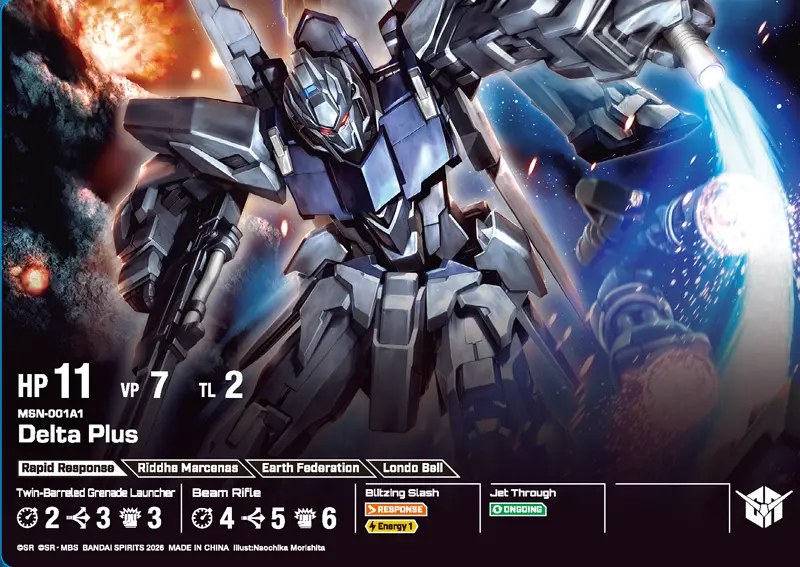
Card number - the code in the corner, e.g. ST01-U01. This is what the duplicate rule checks.
Trait - the keyword line, e.g. Mass Produced or Londo Bell. Traits gate Tactics cards.
Weapons - each weapon prints range, strength and timeline cost.
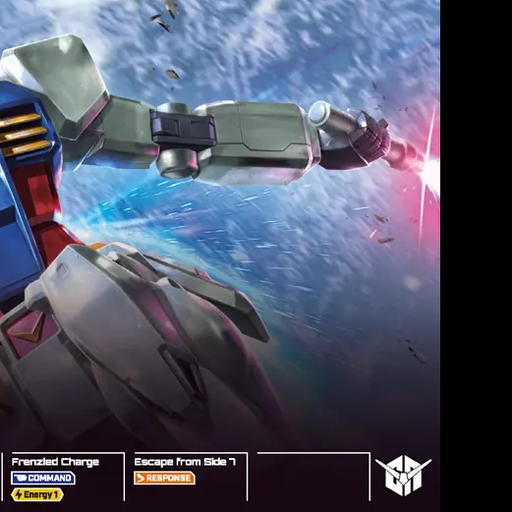
Abilities - Command, Response and Ongoing abilities sit under the weapons.
Starting Timeline - the round the unit first activates.
If a term on your card does not appear here, it is a card-specific keyword and the card text is the authority. The unit card database shows every launch card in one table.