Unpainted, Primed or Painted?
No. Every unit ships unpainted and fully playable; paint is cosmetic. What matters at the table is telling two squads apart, which is why most players at least panel line or paint a shoulder before their second game.
No. Nothing in the Gundam Assemble rules requires painted models. Every miniature ships unpainted - Bandai states it explicitly on each product page - and the game is fully playable straight off the runner.
What the rules say
The rules never mention paint. A unit is defined by its card, not its appearance. You can field a straight-built model, a primed model or a fully painted one and the game is identical.
Why people paint anyway
Three reasons, in order of how much they matter at the table:
Readability. In a 3v3 game you need to tell your three units from your opponent's at a glance across 90 cm of table. Two identical grey RX-78-2s facing each other is the classic confusion.
Ownership. The duplicate rule means you may end up with two of the same card in different squads. Paint is the cheapest way to distinguish them.
It is the hobby. For a lot of players, the 50 mm Gunpla is the point.
The minimum that solves readability
You do not need a full paint job. Three options, cheapest first:
| Approach | Time | Effect |
| Paint one shoulder and the head | 10 min/model | Clearly identifies a squad |
| Panel line only | 10 min/model | Detail reads at table distance, no colour change |
| Wash plus line | 20 min/model | Looks deliberate on bare plastic |
|---|
A single accent colour on one shoulder is enough for most groups. It also comes off easily if you change your mind, which matters when the models cost what they cost.
What Bandai sells for it
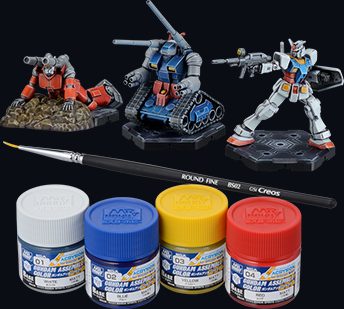
Gundam Assemble Colors is a brush-on range formulated for miniature painting, in Base and Shade variants, aimed at first-time painters. The Mr. Brush BS series covers detail brushes. Paint Pack 01 bundles miniatures, a brush and four colours for $50.
You do not need the official paints. Any acrylic miniature paint works on polystyrene, and the painting guide covers the process without assuming the branded range.
Painting and the duplicate rule
Because duplicates are keyed to card numbers, a legal squad can contain two copies of the same card only if it is Mass Produced - which in the launch pool means two Torohachi. If you do run two, paint the second one differently. It saves an argument in round three.
Tournament and store expectations
The official organised play structure exists (players, judges, stores), but no published paint requirement has been announced. The safe assumption for a store game is "painted or bare, but distinguishable" - and if a judge asks, the rules are on your side.
The practical answer
Build the six starter models, play three games unpainted, then decide. Painting is the part of the hobby that scales with enthusiasm, and a first game does not need it. If you do want to start, the cheapest meaningful upgrade is a panel liner, not a paint set.
For the build side, see gunpla basics; for the paint order, painting and panel lining.
What a bare-plastic squad looks like on the table
Straight-built Gunpla are colour-separated: Bandai moulds different parts in different colours, so a straight build reads as a multi-colour model rather than a grey one. At 50 mm, on a hex map seen from arm's length, the silhouette and the colour blocking are doing all the work.
That is why "unpainted" here does not mean "unfinished grey". The practical problem is not appearance, it is distinguishing two squads that use the same model. The duplicate rule mostly prevents that, except for Mass Produced Torohachi and any mirror match where both players bring the starter's six units.
Stripping and repainting later
If you paint a model and change your mind, acrylic paint comes off polystyrene with isopropyl alcohol and a toothbrush. Do not use acetone or lacquer thinner: both attack the plastic and will melt detail within seconds.
That reversibility is worth knowing before your first attempt, because it lowers the cost of a bad paint job to "an evening with a brush and some alcohol" rather than "a ruined model".