The Timeline Replaces Turns
Every unit has a starting Timeline value and pays timeline cost to act. Its token moves forward that many rounds, so cheap actions come back sooner. Ten rounds end a Phase, and the game runs two Phases.
The Timeline is the part of Gundam Assemble that does not exist in most miniatures games, and it is the part that decides who wins. There are no turns. There is one shared track, ten rounds long, and every unit on the table sits somewhere on it.
The shape of the track
Each player has a side of the track, red and blue. Each unit has a token. When you activate a unit, its token moves forward by the timeline cost you paid, and the unit cannot act again until the round counter reaches that number. Rounds with no tokens on them are skipped.
Ten rounds make a Phase. When round ten ends, Phase one closes and Phase two begins. A game is two Phases.
Starting values decide the opening
Every card prints a starting Timeline value. Across the fifteen launch unit cards the spread is tight but meaningful:
| Starting TL | Units | What it means |
| 1 | 4 of 15 | Acts in round one, and comes back fastest |
| 2 | 7 of 15 | The default; acts in round two |
| 3 | 4 of 15 | Waits three rounds for its first activation |
|---|
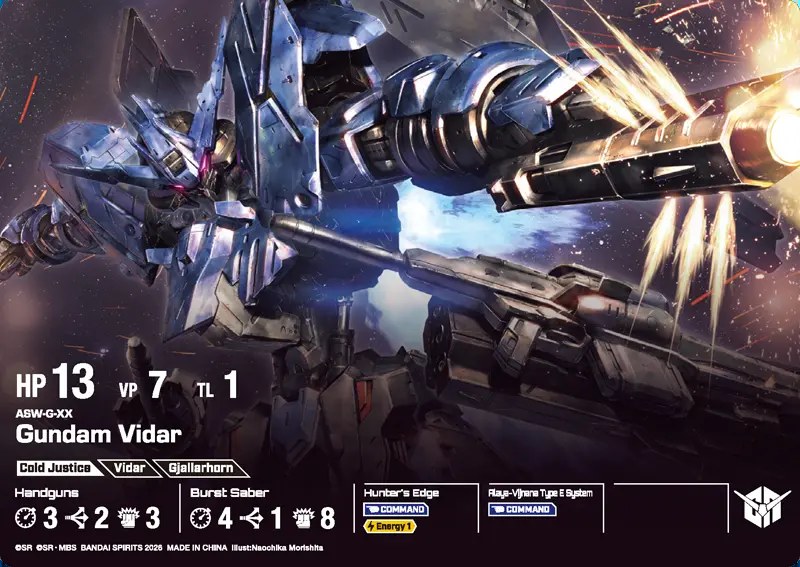
The four value-1 units are Gundam Vidar, Gundam Aerial, the Paint Pack RX-78-2 and the Torohachi. The four value-3 units are Wing Gundam Zero (EW), Gundam Epyon (EW), Unicorn Gundam (Destroy Mode) and Darilbalde. Full stats are in the unit card database.
A value-1 unit with a cheap weapon can activate in round one, again in round four and again in round seven. A value-3 unit with an expensive weapon may only act twice in a Phase. That gap, not raw damage, is usually what separates a good list from a bad one.
Costs are printed, not chosen
When you attack, you pay the weapon's timeline cost. On the starter set's RX-78-2, the Vulcan Guns cost 3 and the Beam Saber costs 6. Energize and Rescue both cost 2. Nothing else moves a token, except destruction: when a unit is destroyed, its token moves two rounds forward and then stays there.
This is why weapon choice is a tempo decision as much as a damage decision. The stronger weapon is not automatically correct if it costs you two extra rounds of relevance.
Stacking and same-round activation
If several tokens land on the same round, they stack. Incoming tokens go underneath existing ones. When the round counter reaches that round, you activate the top token first, then the next, and so on.
You may only choose stacking order once: at setup, when you place initial tokens. After that, order is a consequence of the costs you paid. If both players have tokens on the same round, the quick-start manual gives two procedures - roll a die at setup and let the higher roll start, rerolling ties; once play is underway, start with the opponent of the player who acted last.
Worked example
Take a starter game. Your Gundam (starting TL 2) attacks with the Vulcan Guns in round two, so its token moves to round five. Your opponent's Char's Zaku II (starting TL 2) also acted in round two and moved to round six, because it used a 4-cost weapon. In round three and four nothing happens for either of them. In round five your Gundam acts again; the Zaku waits one more round.
By round eight, the Gundam has acted three times and the Zaku twice. That is the whole system in one exchange: same starting value, different weapon costs, one extra activation.
Playing the clock
Three habits separate players who understand the track from players who do not.
- Count rounds forward, not backward. Before you attack, ask which round this token lands on and whether anything of yours is already there.
- Stack on purpose. Two of your units landing on the same round is not a disaster, but the second one is doing nothing while the first resolves. Spread them if you can.
- Energize before you need it. Spending two timeline for one Energy hurts when you are already behind on activations, and is close to free when the alternative is a long wait anyway.
Phase two
Phase two does not reset the track. The same tokens keep running, which means a unit that acted late in Phase one starts Phase two in the same position. The three extra Tactics cards each player draws at the end of Phase one are the real reset: a fresh hand in a game where tempo has already been established.
If the timeline still feels abstract, the combat page shows what each activation actually produces in damage, and the how to play page runs a first turn end to end.